
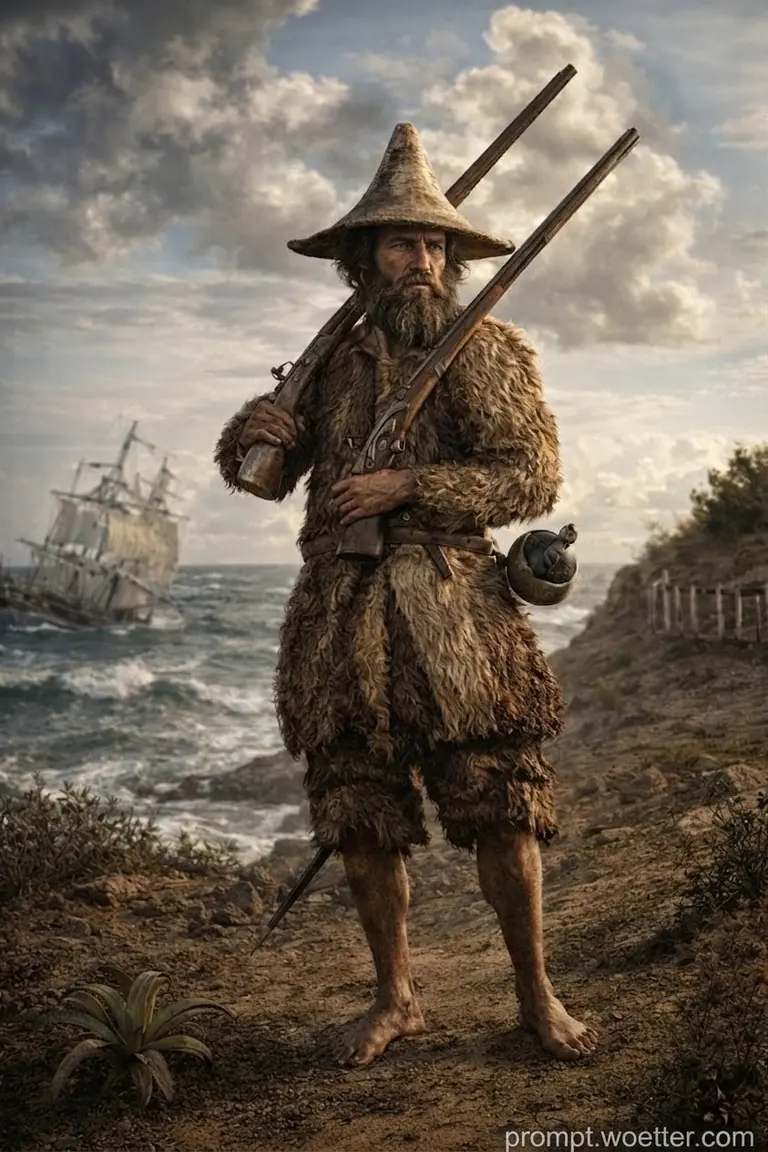

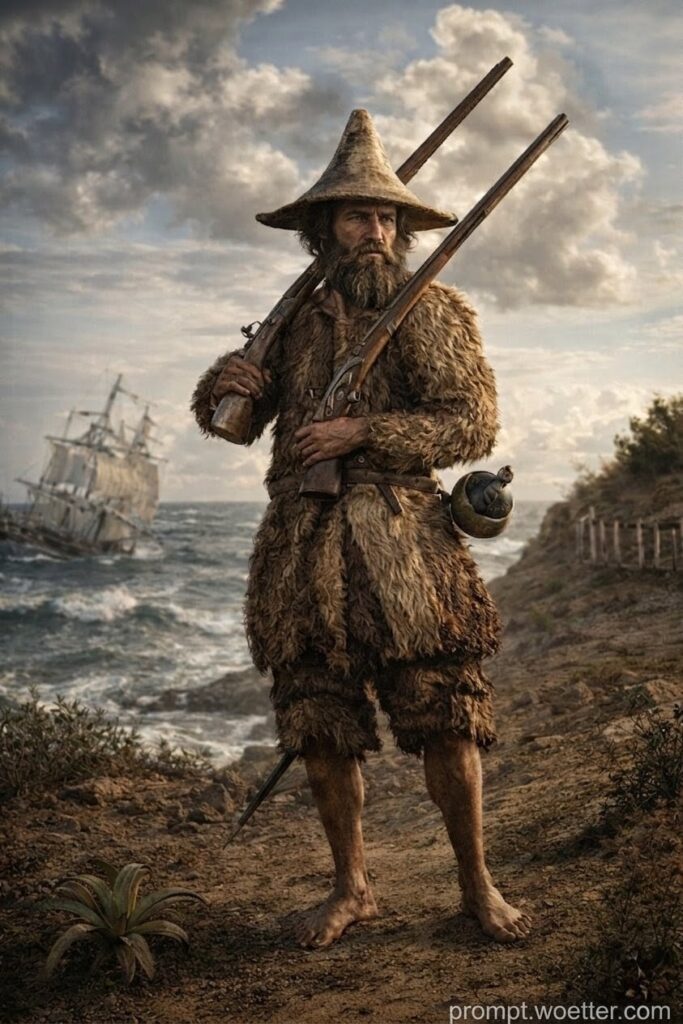
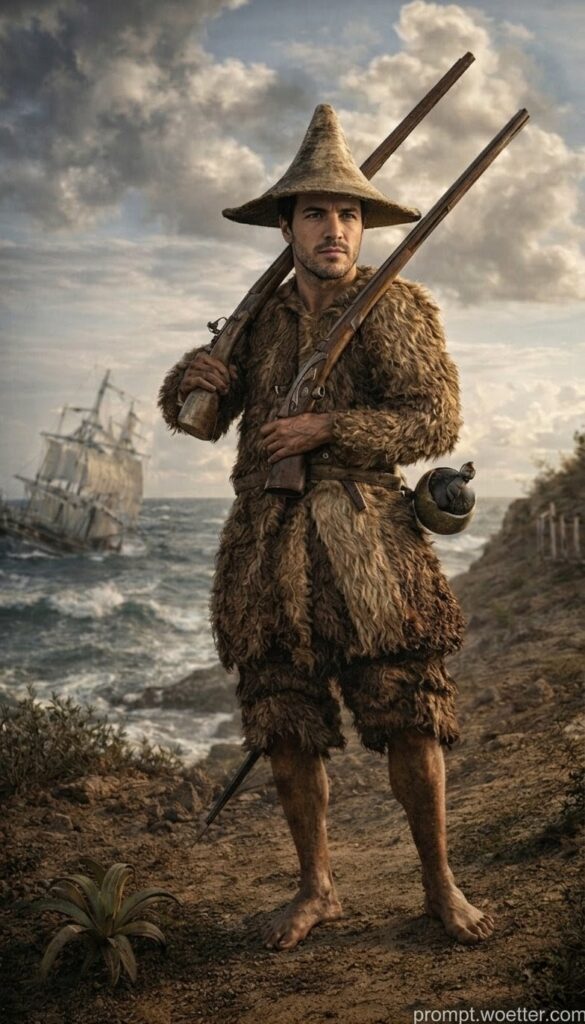
This comprehensive AI image prompt framework allows users to transform their personal photos into hyper-realistic, 18th-century documentary-style portraits. By using the “10-Part Orchestration Framework,” users can seamlessly blend their own facial features onto the body of a rugged, stranded survivor, styled after Robinson Crusoe, complete with cinematic golden hour lighting, intricate fur textures, vintage muskets, and a desolate island backdrop.
The 10-Part Orchestration Framework Image Prompt
Important: For this prompts to work perfectly, you must attach a reference picture of yourself with the AI prompt.
Subject: The exact person from the attached picture — to be dressed just like Robinson Crusoe — a rugged, weathered man with a dark beard and resolute expression, wearing crude hand-stitched animal-skin garments with visible fur texture, earthy browns and dark ochre tones, a tall conical peaked fur hat, leather or hide wrappings on feet and legs. Use the attached reference image directly for all facial and physical likeness. Do not invent or describe facial features independently.
Composition: Full-body portrait, shot from a slightly low angle (camera positioned approximately at mid-thigh height) to emphasize resilience and stature. Subject centered with balanced rule-of-thirds horizon placement.
Action: Standing alert and poised on a windswept shoreline, gripping two vintage flintlock muskets — one in each hand — barrels angled slightly outward. Posture upright, weight slightly forward, as if scanning the horizon for threats.
Location: A remote, desolate island beach, circa 1719. Rough Atlantic ocean waves behind the figure. Wet sand with visible grain and footprints. Distant silhouette of an 18th-century tall ship on the horizon, partially obscured by sea mist. Windswept dune grass and driftwood at the edges of frame.
Style: Hyper-realistic 2026 flagship digital photography, documentary photojournalism aesthetic. Must read as a genuine photograph taken on-location in 1719, captured with modern sensor technology. Zero illustration artifacts, zero painterly brush strokes, zero AI-art visual signatures. Inspired by National Geographic documentary portraiture, Steve McCurry environmental portrait work, and Blade Runner 2049 color grading.
Editing Instructions: Desaturated warm earth tones — raw sienna, dark umber, weathered ochre, ash grey, muted ocean blue-grey. Golden amber highlights from the low sun. High micro-contrast with restrained overall saturation. Do not override the subject with generic male attributes.
Refining Details: Hyper-detailed surface rendering: individual fur strands on garments and hat, pore-level weathered skin texture, visible sand grains adhering to boots, rust patina and barrel scratches on muskets, crude hide stitching with sinew thread, salt-weathered leather bindings.
Camera, Lighting and Format: High-end 2026 flagship digital sensor, 100MP+. 50mm prime lens. Aperture f/2.8 for subtle background separation. RAW format. Golden hour cinematic natural lighting. Warm, low-angle sun casting long dramatic shadows across the sand. Rim lighting on the fur hat and shoulder garments. No artificial fill — raw, unmanipulated daylight quality.
Composition and Aspect Ratio: Shallow depth-of-field isolating the subject while preserving environmental context. Aspect Ratio 4:5.
Camera and Lighting Details: 50mm prime lens, f/2.8 aperture, RAW format. Golden hour, natural lighting condition only.
Specific Text Integration: Watermark text "prompt.woetter.com" at the bottom-right. Small, legible, sans-serif font, white color, 20% opacity, 50px padding from right and bottom edges.
Factual Constraints: --no illustration, painting, cartoon, anime, 3D render, CGI, digital art aesthetic, AI art visual signature, soft focus, overexposed, studio lighting, fantasy, invented facial features, generic face.
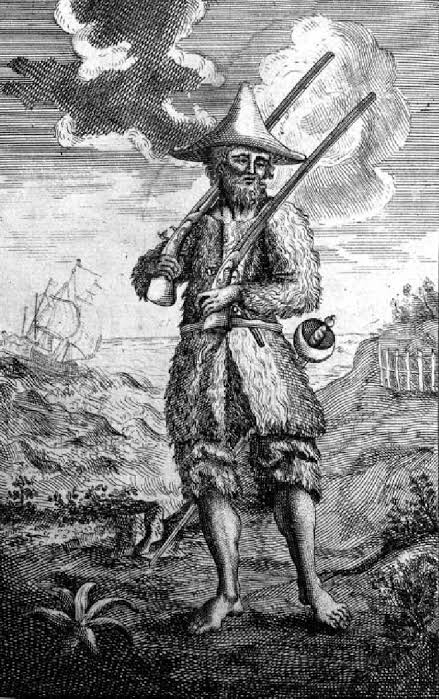
Reference Entries: [ATTACH: Your Personal Picture] + [ATTACH: 1st edition Robinson Crusoe cover illustration to be used as character reference for costume and prop accuracy].
Dissecting the Master Prompt: How It Works
Creating a seamless, photorealistic image of yourself in a historical setting requires strict prompt engineering. Here is a breakdown of why this 10-Part Orchestration Framework yields such high-end results:
1. Anchoring the Subject to Your Photo
By emphatically repeating “the exact person from the attached picture” and strictly telling the AI not to invent facial features, we force the image generator (like Midjourney, Stable Diffusion, or DALL-E) to prioritize your reference image. You must remember to attach your photo for this to work!
2. High-Fidelity Texturing
Words like pore-level weathered skin, visible sand grains, and rust patina push the AI away from smooth, plastic-looking “CGI” renders and towards gritty, tactile realism.
3. Camera and Sensor Specs
Specifying “2026 flagship digital sensor, 100MP+” and “50mm prime lens f/2.8” dictates the exact optical physics the AI should emulate. It creates a natural background blur (bokeh) that isolates the subject while keeping the ocean background recognizable but soft.
4. Advanced Lighting Prompts
Instead of just saying “good lighting,” we use “Golden hour cinematic natural lighting” and specify “Rim lighting on the fur hat.” This creates dynamic contrast and a professional, studio-quality aesthetic without looking artificially lit.
5. Negative Constraints
The negative constraints are vital here. Instructing the AI to avoid “generic face,” “illustration,” and “AI art visual signature” guarantees that the output feels like a true documentary photograph rather than a digital painting.
JSON Prompt
{
  "subject": "The exact person from the provided reference image — to be dressed as Robinson Crusoe — a rugged, weathered man with a dark beard and resolute expression, wearing crude hand-stitched animal-skin garments with visible fur texture, earthy browns and dark ochre tones, a tall conical peaked fur hat, leather or hide wrappings on feet and legs. Use the reference image directly for all facial and physical likeness. Do not invent or describe facial features independently.",

  "composition": "Full-body portrait, shot from a slightly low angle (camera positioned approximately at mid-thigh height) to emphasize resilience and stature. Subject centered with balanced rule-of-thirds horizon placement.",

  "action": "Standing alert and poised on a windswept shoreline, gripping two vintage flintlock muskets — one in each hand — barrels angled slightly outward. Posture upright, weight slightly forward, as if scanning the horizon for threats.",

  "location": "A remote, desolate island beach, circa 1719. Rough Atlantic ocean waves behind the figure. Wet sand with visible grain and footprints. Distant silhouette of an 18th-century tall ship on the horizon, partially obscured by sea mist. Windswept dune grass and driftwood at the edges of frame.",

  "lighting": "Golden hour cinematic natural lighting. Warm, low-angle sun casting long dramatic shadows across the sand. Rim lighting on the fur hat and shoulder garments. No artificial fill — raw, unmanipulated daylight quality.",

  "camera_and_lens": "High-end 2026 flagship digital sensor, 100MP+. 50mm prime lens. Aperture f/2.8 for subtle background separation. RAW format. Shallow depth-of-field isolating the subject while preserving environmental context.",

  "style": "Hyper-realistic 2026 flagship digital photography, documentary photojournalism aesthetic. Must read as a genuine photograph taken on-location in 1719, captured with modern sensor technology. Zero illustration artifacts, zero painterly brush strokes, zero AI-art visual signatures.",

  "style_references": [
    "National Geographic documentary portraiture",
    "Steve McCurry environmental portrait work",
    "Blade Runner 2049 — cinematography by Roger Deakins (color grading reference only)",
    "1st edition Robinson Crusoe cover illustration — use as character reference for costume and prop accuracy"
  ],

  "color_palette": "Desaturated warm earth tones — raw sienna, dark umber, weathered ochre, ash grey, muted ocean blue-grey. Golden amber highlights from the low sun. High micro-contrast with restrained overall saturation.",

  "texture_detail": "Hyper-detailed surface rendering: individual fur strands on garments and hat, pore-level weathered skin texture, visible sand grains adhering to boots, rust patina and barrel scratches on muskets, crude hide stitching with sinew thread, salt-weathered leather bindings.",

  "aspect_ratio": "4:5 (portrait orientation)",

  "technical_specs": {
    "sensor": "100MP+ full-frame 2026 flagship",
    "lens": "50mm prime",
    "aperture": "f/2.8",
    "format": "RAW",
    "lighting_condition": "Golden hour, natural only"
  },

  "negative_prompt": [
    "illustration",
    "painting",
    "cartoon",
    "anime",
    "3D render",
    "CGI",
    "digital art aesthetic",
    "AI art visual signature",
    "soft focus",
    "overexposed",
    "studio lighting",
    "fantasy",
    "invented facial features",
    "generic face"
  ],

  "reference_image": "[ATTACH: 1st edition Robinson Crusoe cover] — Use as direct character reference for face, build, costume construction, hat shape, and musket props. Do not override with generic male attributes.",

  "watermark": {
    "text": "prompt.woetter.com",
    "position": "bottom-right",
    "font": "small, legible, sans-serif",
    "color": "white",
    "opacity": "20%",
    "padding": "50px from right and bottom edges"
  }
}
Fluid Text Version of the Image Prompt
Use the attached picture of a person for the subject's face. Create a hyper-realistic 2026 flagship digital full-body portrait of the exact person from the attached picture, dressed like Robinson Crusoe. The subject is a rugged, weathered man wearing crude hand-stitched animal-skin garments with visible fur texture, a conical fur hat, and leather leg wrappings. He is standing alert on a desolate, windswept island beach circa 1719, gripping two vintage flintlock muskets. Shot from a slightly low angle with a 50mm prime lens at f/2.8, RAW format, 100MP+. The lighting is natural cinematic golden hour, casting long dramatic shadows and rim lighting on the fur. The background features rough Atlantic waves, wet sand, and the distant misty silhouette of an 18th-century tall ship. The style is National Geographic documentary photojournalism with desaturated warm earth tones, raw sienna, and high micro-contrast. Hyper-detailed textures on the fur, weathered skin, sand on boots, and rust on the muskets. Add a small, 20% opacity white watermark "prompt.woetter.com" in the bottom right corner. Aspect ratio 4:5. --no illustration, painting, cartoon, 3D render, generic face, soft focus.
If you found this guide helpful, please share this post with your friends and fellow AI art enthusiasts using the social share buttons below!
I can’t wait to see you stranded on that cinematic beach. Tag me on social media using #promptwoetter so I can check out your epic Robinson Crusoe versions!